

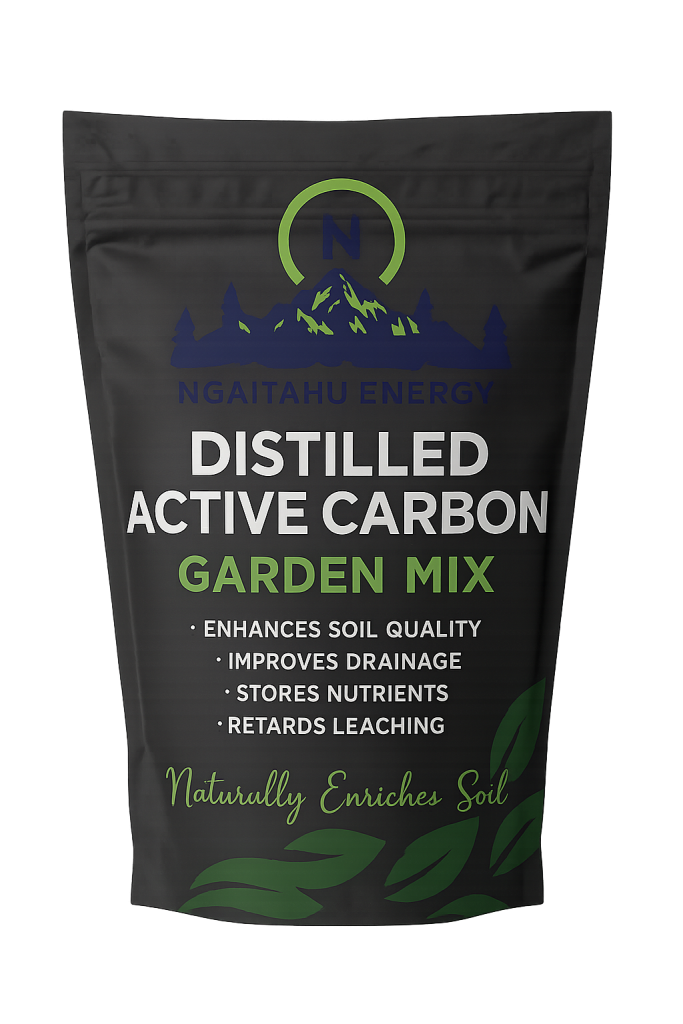
Ngaitahu Energy Limited [NEL] Distilled Active Carbon [NEL DAC] is a porous, carbon-rich material that is made from biomass through a thermochemical conversion process in a limited oxygen environment. Put simply, it’s a form of charcoal. NEL DAC CCT system produces NEL DAC at scale and in a controlled emissions environment.
Whilst NEL DAC has gained prominence in recent times due to its ability to capture and store carbon, its benefits were being realised thousands of years ago by the indigenous peoples of the Amazon, who mixed a combination of charcoal and organic matter into the soil to improve soil fertility.
This, combined with the insatiable demand for NEL DAC carbon offset credits,
presents a compelling investment proposition for NEL DAC production
NEL DAC’s CCT system is optimised to produce NEL DAC and energy from agricultural and forestry waste biomass such as nutshells, wood chips, and biosolids . The yield, properties and value of the NEL DAC varies depending on the feedstock.
NEL DAC’s scientifically proven ability to capture and store carbon in a stable form for hundreds or thousands of years, makes it one of the leading Carbon Dioxide Removal methods.
NEL DAC has analysed and trialled a wide range of feedstock, get in touch today to find out more.
The core component of the NEL DAC CCT system is the hearth, which is a modified updraft gasifier that is fitted with our proprietary high temperature components and controls.
The off-gases travel up through the hearth to the thermal oxidiser, where they are mixed with more air and oxidised completely through to water and carbon dioxide. The feedstock is then transported through a number of chambers before dropping out into a screw conveyor where it is quenched and discharged as biochar.
The temperature and oxygen profiles in the hearth are controlled to achieve the desired biochar yield and quality. Temperatures in the hearth range from 500°C to 750°C.
The thermal oxidiser is controlled to a selected temperature in the range between 850°C to 1100°C according to the nature of the biomass and the emissions control requirements. Oxygen is monitored and controlled to achieve complete oxidation of the combustible gases. Downstream, a heat recovery system and emissions controls (venturi/wet scrubber/ESP) can be included into the system.
The system is controlled by a PLC which can be operated from a local or remote mounted HMI/SCADA.
The core component of the NEL DAC CCT system is the hearth, which is a modified updraft gasifier that is fitted with our proprietary high temperature components and controls.
Feedstock is continuously metered into the top chamber of the hearth where it rapidly heats, dries and commences to pyrolyse (thermally decompose). A small fraction of the volatile components released from the feedstock are mixed with a controlled amount of air and ignite. Partial combustion of volatile components in the hearth provides the heat that makes the process autothermal.
The off-gases travel up through the hearth to the thermal oxidiser, where they are mixed with more air and oxidised completely through to water and carbon dioxide. The feedstock is then transported through a number of chambers before dropping out into a screw conveyor where it is quenched and discharged as NEL DAC.
The temperature and oxygen profiles in the hearth are controlled to achieve the desired NEL DAC yield and quality. Temperatures in the hearth range from 500°C to 750°C.
The thermal oxidiser is controlled to a selected temperature in the range between 850°C to 1100°C according to the nature of the biomass and the emissions control requirements. Oxygen is monitored and controlled to achieve complete oxidation of the combustible gases. Downstream, a heat recovery system and emissions controls (venturi/wet scrubber/ESP) can be included into the system.
The system is controlled by a PLC which can be operated from a local or remote mounted HMI/SCADA.
The core component of the NEL DAC CCT system is the hearth, which is a modified updraft gasifier that is fitted with our proprietary high temperature components and controls.
Feedstock is continuously metered into the top chamber of the hearth where it rapidly heats, dries and commences to pyrolyse (thermally decompose). A small fraction of the volatile components released from the feedstock are mixed with a controlled amount of air and ignite. Partial combustion of volatile components in the hearth provides the heat that makes the process autothermal.
The off-gases travel up through the hearth to the thermal oxidiser, where they are mixed with more air and oxidised completely through to water and carbon dioxide. The feedstock is then transported through a number of chambers before dropping out into a screw conveyor where it is quenched and discharged as NEL DAC.
The temperature and oxygen profiles in the hearth are controlled to achieve the desired NEL DAC yield and quality. Temperatures in the hearth range from 500°C to 750°C.
The thermal oxidiser is controlled to a selected temperature in the range between 850°C to 1100°C according to the nature of the biomass and the emissions control requirements. Oxygen is monitored and controlled to achieve complete oxidation of the combustible gases. Downstream, a heat recovery system and emissions controls (venturi/wet scrubber/ESP) can be included into the system.
The system is controlled by a PLC which can be operated from a local or remote mounted HMI/SCADA.
The foundations of NEL DAC business are built on the UN’s Sustainable Development Goals. We strive to continually innovate and adapt to deliver genuine economic, environmental and social outcomes for our clients and communities.
